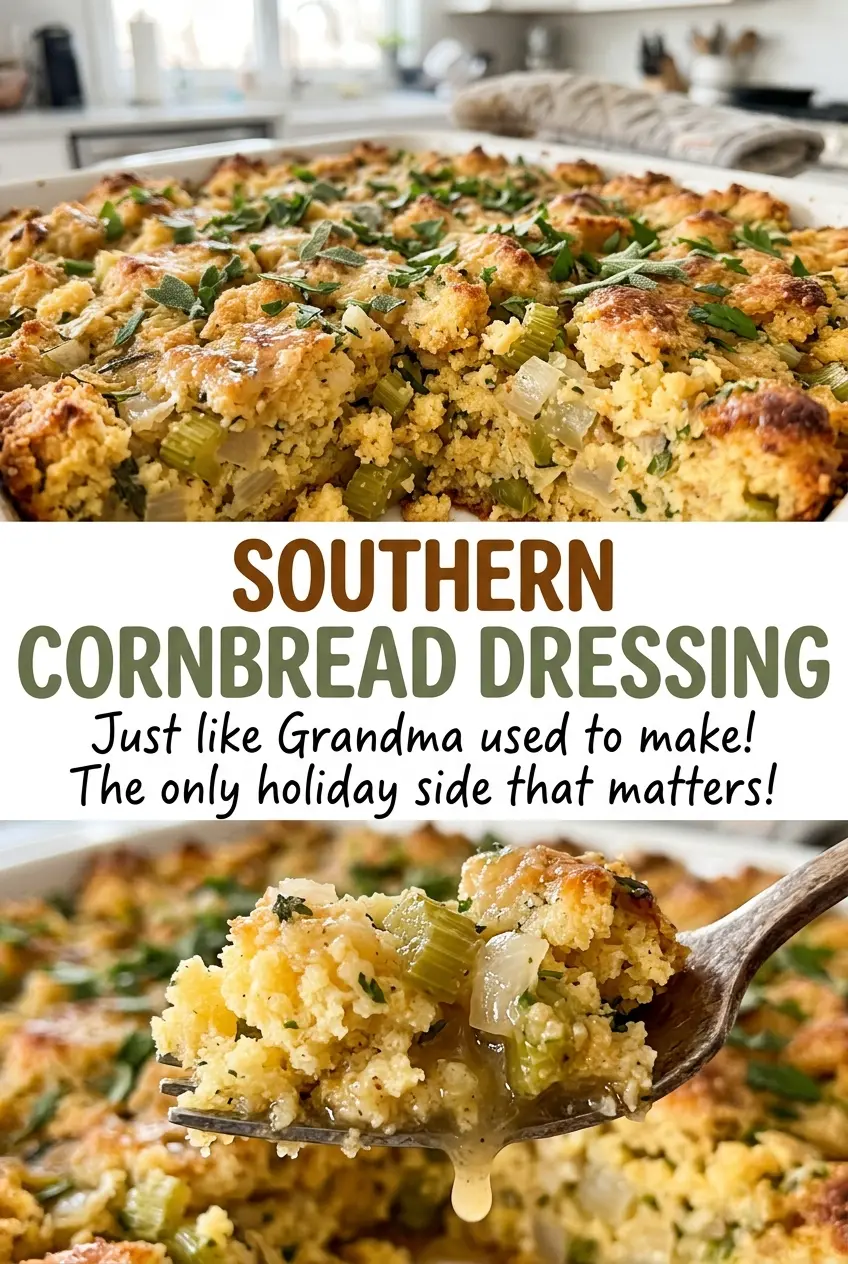
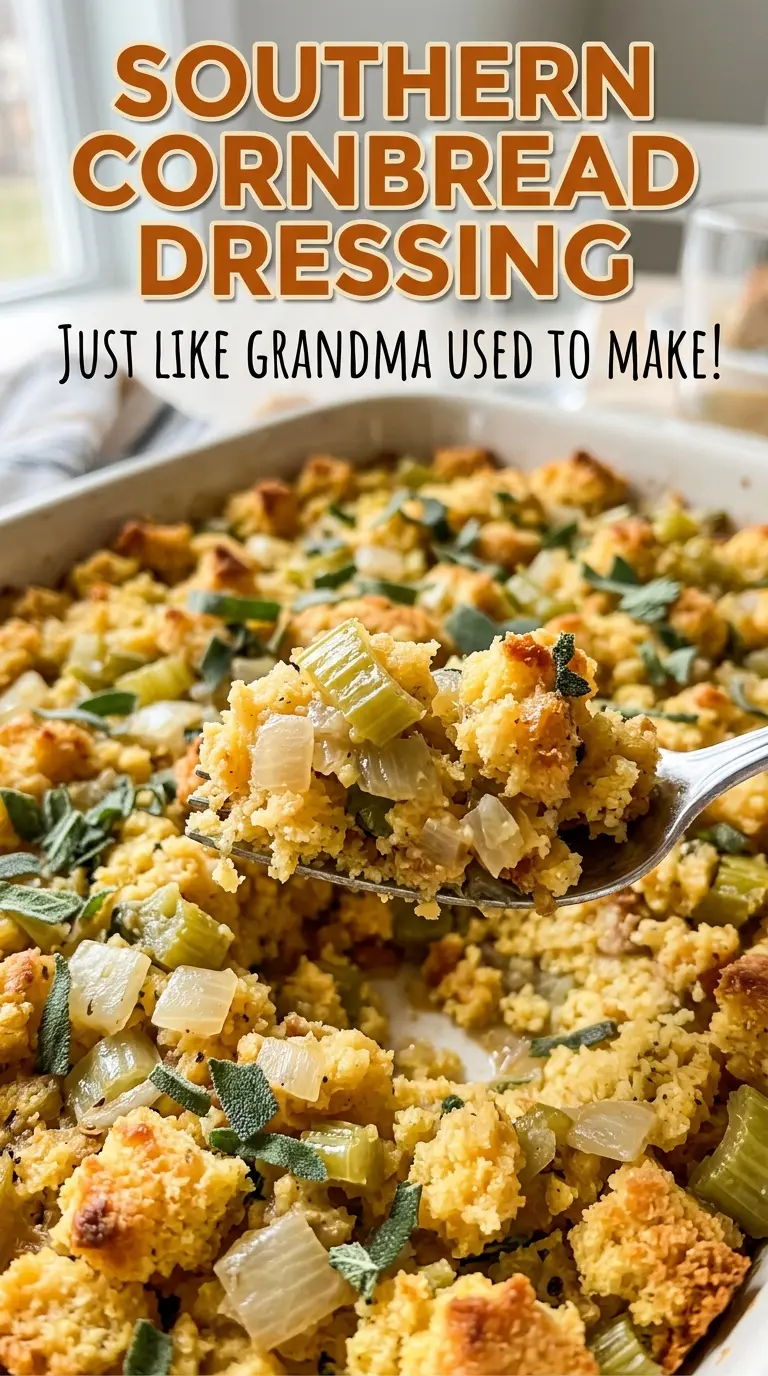
When I lift the foil from the baking dish, the top is still pale; those last minutes uncovered turn it golden while the center finishes setting. Southern cornbread dressing rewards that little contrast: browned edges, a tender middle, and the warm scent of sage rising as you bring it to the table. I bake the cornbread for this version myself, so its corn flavor stays front and center instead of getting lost in a very soft, all-bread casserole.
The onion and celery cook in butter before they meet the bread, which softens their bite and lets their savory flavor carry through each serving. Eggs and broth bring everything together, while a short rest after baking helps the dressing hold its shape when you spoon it out. The finished pan is moist without being mushy, with a golden top and the comforting aroma of sage and butter.
Kitchen Note
Let the cornbread cool completely in its pan before crumbling it. Warm cornbread tends to break into sticky clumps, while cooled pieces crumble cleanly into the dressing.
Save this Southern cornbread dressing for a meal that calls for a golden top, tender center, and warm sage flavor.
Why This Dressing Needs Two Kinds of Bread, Not Just More Cornbread
Cornbread gives this dressing its familiar corn flavor and a tender, slightly crumbly texture. If it were the only bread in the pan, the pieces would soften into a looser, more fragile bake once the broth and eggs were added. White sandwich bread brings a finer crumb that helps the mixture hold together, so a serving can be scooped without turning into a bowl of soft crumbs.
The two breads also take up moisture differently. The sandwich bread cubes are dried until crisp, giving them room to absorb broth during assembly. The cornbread starts out tender, so it contributes body and flavor without needing to be dried along with the cubes. That contrast is what keeps the center moist while the top browns in the oven.
Keep the bread pieces distinct when you combine them. Crumbling the cooled cornbread into the dried cubes gives you a mix of textures; stirring or pressing too hard can flatten it into a dense mass. Fold in the liquid until the bread is evenly moistened, then let the oven set the dressing rather than trying to mash the mixture into shape.
What Each Bread and Binder Brings to Southern Cornbread Dressing
- Yellow cornmeal — This supplies the unmistakable corn flavor and a little texture in the homemade cornbread. A medium-ground cornmeal gives a balanced crumb; a much finer grind makes the cornbread more delicate. Corn flour isn’t an equal swap because it doesn’t give the same texture.
- All-purpose flour — Flour works with the cornmeal to give the cornbread enough structure to crumble into the dressing. Replacing all of it with more cornmeal would make the cornbread more fragile and change how it holds together.
- Buttermilk — Its tang keeps the cornbread from tasting flat, and its acidity works with the baking soda. If you don’t have buttermilk, stir 1 1/2 tablespoons of lemon juice or white vinegar into enough milk to make 1 1/2 cups, then let it stand for 5 minutes before using; the flavor will be a little less rich.
- Unsalted butter — Butter gives the cornbread and softened vegetables their rounded, savory flavor. Unsalted butter lets you control the seasoning; salted butter can make the dressing taste saltier than intended.
- White sandwich bread — Its mild flavor and fine crumb balance the more pronounced cornmeal. Drying the cubes in the oven gives them a useful crispness before they absorb broth, so fresh bread works just as well as day-old bread.
- Yellow onion and celery — Chop both finely so they soften evenly and distribute through the dressing instead of leaving large crunchy pieces. Fresh vegetables matter more here than a particular variety; choose firm celery and an onion without soft spots.
- Rubbed sage — The leafy pieces give the dressing its recognizable herbal aroma. Rubbed sage is different from finely ground sage, so don’t replace it measure for measure with ground sage.
- Low-sodium chicken broth — This moistens the bread while leaving room for the salt in the dressing. Low-sodium broth is the better choice if you want the seasoning to stay balanced; regular broth may make the finished pan saltier.
Build the Dressing in Four Stages for a Tender Center
Bake the cornbread until its center is set
Heat the oven to 400°F and grease an 8-inch square baking pan with 1 1/2 teaspoons of vegetable oil. Whisk the cornmeal, flour, baking powder, baking soda, and salt in one bowl, then whisk the buttermilk and eggs in another before adding the melted butter. Stir the wet mixture into the dry ingredients just until combined; overmixing can make the cornbread tough. Bake for 20–25 minutes, until golden and a toothpick inserted in the center comes out clean, then cool completely in the pan.
Dry the sandwich bread cubes until crisp
Lower the oven to 250°F and spread the bread cubes on a baking sheet in an even layer. Bake for 25–35 minutes, stirring once, until the cubes feel dry and crisp rather than soft in the middle. If they still feel pliable, give them more time within that range and check again; damp cubes take up broth differently. Set them aside while you crumble the cooled cornbread into a large bowl.
Soften the vegetables before seasoning the bread
Grease a 9×13-inch baking dish with the remaining 1 1/2 teaspoons of vegetable oil. Melt the butter in a 12-inch skillet over medium heat, add the finely chopped onion and celery, and cook for 8–10 minutes, stirring occasionally, until tender. If the vegetables are still firm, keep cooking until they soften; big, undercooked pieces stand out in the finished dressing. Stir the cooked vegetables, rubbed sage, salt, and pepper into the cornbread and dried bread.
Fold in the broth, then bake covered and uncovered
Whisk the broth with the remaining eggs and pour it over the bread mixture. Fold gently until everything is evenly moistened, then transfer the mixture to the prepared baking dish without packing it down. Cover with foil and bake at 350°F for 30 minutes, then uncover and bake for 15–20 minutes more, until the top is golden, the center is set, and the center reaches at least 160°F. Let the dressing rest for 10 minutes before serving so it settles enough to scoop.
Three Practical Ways to Adapt This Cornbread Dressing
Make a gluten-free version
Use a gluten-free 1:1 flour blend in place of the all-purpose flour, and gluten-free sandwich bread in place of the white bread cubes. The cornbread and dressing may be more delicate, so fold the broth mixture gently and avoid pressing the bread together.
Keep the sage flavor gentler
Use 1 1/2 teaspoons of rubbed sage instead of 2 teaspoons for a milder herbal note. The dressing will still have a savory, buttery base, but the sage won’t be as prominent in each bite.
Make the pan more cornbread-forward
Use fewer white bread cubes and let the cornbread make up more of the mixture. The corn flavor will come through more strongly, and the dressing will be softer and less firm when served.
Storage and Reheating
- Refrigerator: Store covered for 3–4 days. The dressing softens as it sits, but the flavor remains savory.
- Freezer: Freeze cooled portions in airtight containers for up to 3 months. Thaw in the refrigerator before reheating for more even warming.
- Reheating: Cover the dish with foil and warm it in a 325°F oven until heated through to 165°F. Don’t reheat uncovered from the start, or the top may dry out before the center is hot.
Questions That Come Up When Making Southern Cornbread Dressing
Southern Cornbread Dressing
Ingredients
Equipment
Method
- Heat the oven to 400°F and grease an 8-inch square baking pan with 1 1/2 teaspoons of the vegetable oil.
- Whisk the cornmeal, flour, baking powder, baking soda, and salt in a large bowl.
- In a separate bowl, whisk the buttermilk and 2 eggs, then whisk in the melted butter.
- Stir the wet ingredients into the dry ingredients just until combined.
- Pour the batter into the prepared pan and bake for 20–25 minutes, until golden and a toothpick inserted in the center comes out clean.
- Cool completely in the pan.
- Reduce the oven to 250°F and spread the bread cubes on a baking sheet.
- Bake for 25–35 minutes, stirring once, until dry and crisp.
- Grease a 9x13-inch baking dish with the remaining 1 1/2 teaspoons vegetable oil.
- Crumble all the cooled cornbread into a large bowl with the dried bread cubes.
- Melt the butter in a 12-inch skillet over medium heat, add the onion and celery, and cook for 8–10 minutes, stirring occasionally, until tender.
- Stir the cooked vegetables, sage, salt, and pepper into the bread mixture.
- Whisk the broth with the remaining 2 eggs and pour over the mixture, folding until evenly moistened.
- Transfer to the prepared baking dish, cover with foil, and bake at 350°F for 30 minutes.
- Uncover and bake for 15–20 minutes more, until golden on top, set in the center, and at least 160°F in the center.
- Rest for 10 minutes before serving.