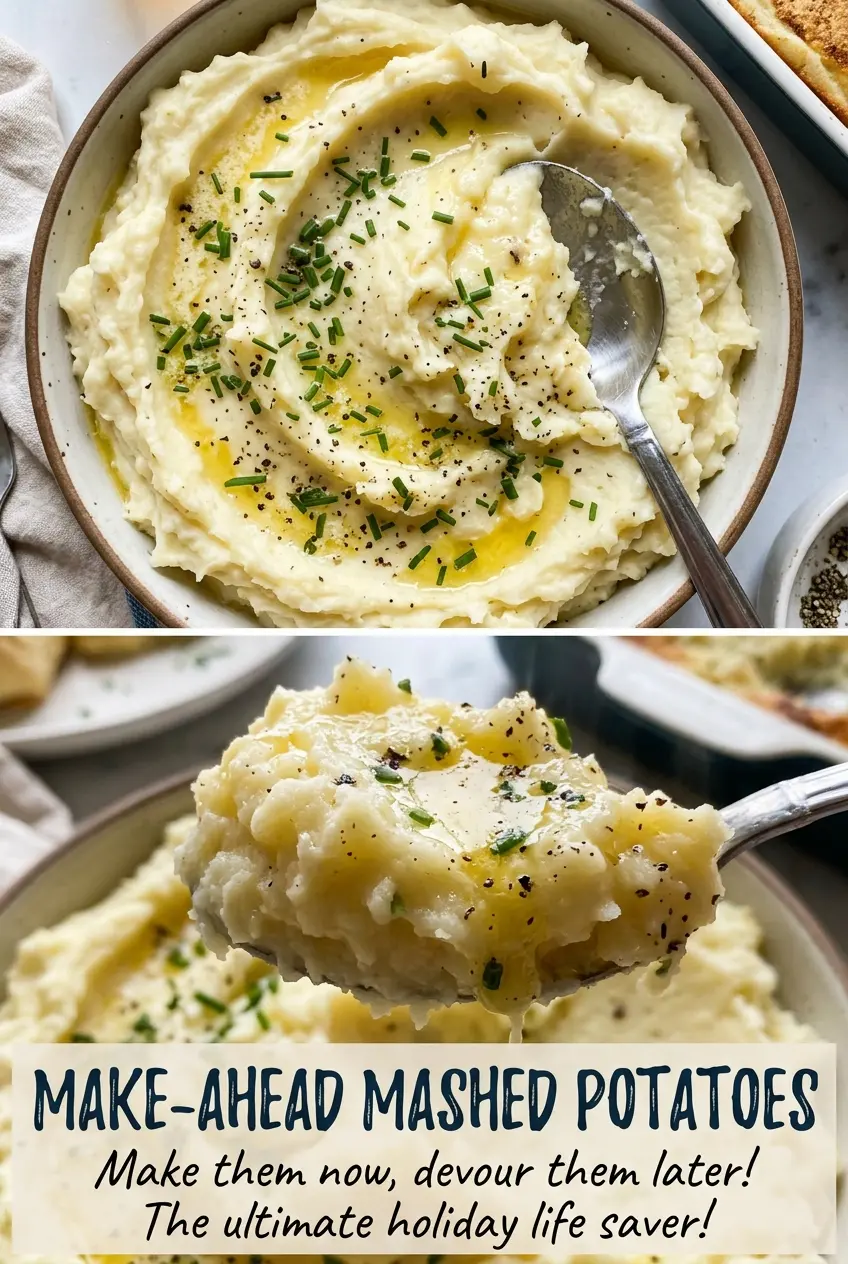
Steam rises in a soft cloud when the potatoes are drained, and that’s the moment I used to wish I could skip on a busy dinner day. These make-ahead mashed potatoes solve that problem: the creamy mash goes into its baking dish ahead of time, then gets warmed in the oven when it’s needed. The potatoes stay rich and tender, not stiff and dry, and the work is already done before the kitchen gets crowded.
I use Yukon Gold potatoes for their naturally creamy texture, then fold in warm milk, softened butter, and sour cream. The make-ahead part is simple, but the pan matters: a 9×13-inch dish gives the potatoes room to reheat in an even layer, and a halfway stir brings the cooler center and warmer edges back together. The finished potatoes are smooth, buttery, and ready to spoon onto the table.
Kitchen Note
I let the dish cool for no more than 30 minutes before covering it. Don’t leave it sitting on the counter while you move on to other kitchen jobs; refrigerate it within 2 hours.
Save these make-ahead mashed potatoes for a buttery, creamy side you can finish in the oven when dinner is close.
Why the 9×13 Dish Matters When You Reheat Mashed Potatoes
A deep pot of chilled mashed potatoes can warm unevenly: the outside heats first while the center stays cold. Spreading the mash in a 9×13-inch baking dish gives it a broad, even layer, so it’s easier to bring the whole pan back to serving temperature. The center still takes longer than the edges, which is why the halfway stir is worth doing rather than just letting the dish sit untouched in the oven.
That stir also gives you a chance to move the warmer potatoes from the sides toward the middle and smooth the surface again. Keep the foil on tightly while the dish bakes; it helps hold in moisture as the potatoes heat. The goal isn’t to brown the top. It’s a warm, soft spoonful from the center as well as the edges, with the creamy texture intact.
Why Yukon Golds, Sour Cream, and Warm Milk Belong in This Mash

- Yukon Gold potatoes — Their naturally buttery, creamy texture suits a mash that will be chilled and warmed again. Choose potatoes that feel firm, without soft spots. Peeling and cutting them into evenly sized pieces helps them cook at the same pace.
- Whole milk — Warm milk blends into the potatoes without cooling them abruptly, and its richness helps keep the mash supple. Whole milk is the best fit for the texture here; lower-fat milk makes a less rich result.
- Sour cream — It brings a gentle tang and a creamy body that plain milk alone won’t provide. Bring it to room temperature before mixing it in so it incorporates smoothly with the warm potatoes.
- Unsalted butter — Softened butter blends into the mash without leaving cold pieces behind. Keeping it unsalted lets the divided kosher salt season the potatoes without having to account for salt in the butter.
- Black pepper — It gives the creamy potatoes a little warmth without distracting from the potato and dairy. Use freshly ground pepper if you like a more aromatic finish; ordinary ground pepper works, too.
From Tender Potatoes to a Hot, Creamy Pan
Simmer the Pieces Until Fork-Tender
Put the peeled, 1 1/2-inch potato pieces in a 6-quart pot and cover them with cold water by 1 inch. Stir in 2 teaspoons of the kosher salt, then bring the water to a boil over high heat. Lower the heat and simmer for 15–20 minutes, checking for a fork to slide through the pieces without resistance. If the centers are still firm, give them more time before draining.
Drain Well and Dry the Potatoes
Drain the potatoes thoroughly, then return them to the pot and set it over low heat for 1 minute. This short dry-out helps excess water evaporate instead of diluting the butter and dairy. Keep the pot on low rather than letting the potatoes scorch; you’re drying them, not browning them. They should look steamy and matte rather than wet on the surface.
Mash in the Warm Dairy
Mash the potatoes, then mix in 7 tablespoons of the softened butter, the warm milk, room-temperature sour cream, the remaining 1 teaspoon of salt, and the black pepper. Stir until everything is combined and the mash looks creamy throughout. Add the ingredients while the potatoes are still warm so the butter blends in evenly. Stop once the mixture is smooth to your liking; heavy, prolonged mashing can make potatoes gluey.
Fill the Dish and Reheat Evenly
Grease a 9×13-inch baking dish with the remaining 1 tablespoon of butter and transfer the potatoes into it. Let the dish cool before covering and refrigerating it. When it’s time to serve, heat the oven to 350°F, cover the dish tightly with foil, and bake for 45–55 minutes, stirring once halfway through. The center should be hot all the way through, not merely warm around the edges.
Two Texture Choices That Change the Finished Mash
Keep it rustic with a few small pieces
For a more rustic texture, leave a few small potato pieces visible when you mash. The dairy still makes the potatoes creamy, but each serving has more bite than a completely smooth mash.
Make the mash more uniform
Mash until there are no visible chunks before stirring in the dairy for a more uniform texture. Keep the mixing gentle once the potatoes are smooth; pushing them far past that point can make the finished mash dense and sticky.
Storage and Reheating
- Refrigerator: Store the covered dish for up to 2 days. The chilled potatoes will be firmer than they were when freshly mashed.
- Freezer: I don’t recommend freezing this batch; the dairy-based mash may turn grainy or separate after thawing.
- Reheating: Cover tightly with foil and warm in a 350°F oven for 45–55 minutes, stirring once halfway through. The center needs to reach 165°F; don’t judge doneness by the warmer edges alone.
Questions That Come Up With Make-Ahead Mashed Potatoes
Make-Ahead Mashed Potatoes
Ingredients
Equipment
Method
- Place the potatoes in a 6-quart pot and cover with cold water by 1 inch.
- Stir in 2 teaspoons of the salt.
- Bring to a boil over high heat.
- Reduce the heat and simmer for 15–20 minutes, until the potatoes are fork-tender.
- Drain well, return the potatoes to the pot, and set over low heat for 1 minute to dry.
- Mash the potatoes.
- Mix in 7 tablespoons of the butter, the warm milk, sour cream, remaining 1 teaspoon salt, and pepper until combined.
- Grease a 9x13-inch baking dish with the remaining 1 tablespoon butter.
- Transfer the potatoes to the dish.
- Let cool for up to 30 minutes, then cover and refrigerate within 2 hours; store for up to 2 days.
- Heat the oven to 350°F.
- Cover the dish tightly with foil.
- Bake for 45–55 minutes, stirring once halfway through, until the center reaches 165°F.