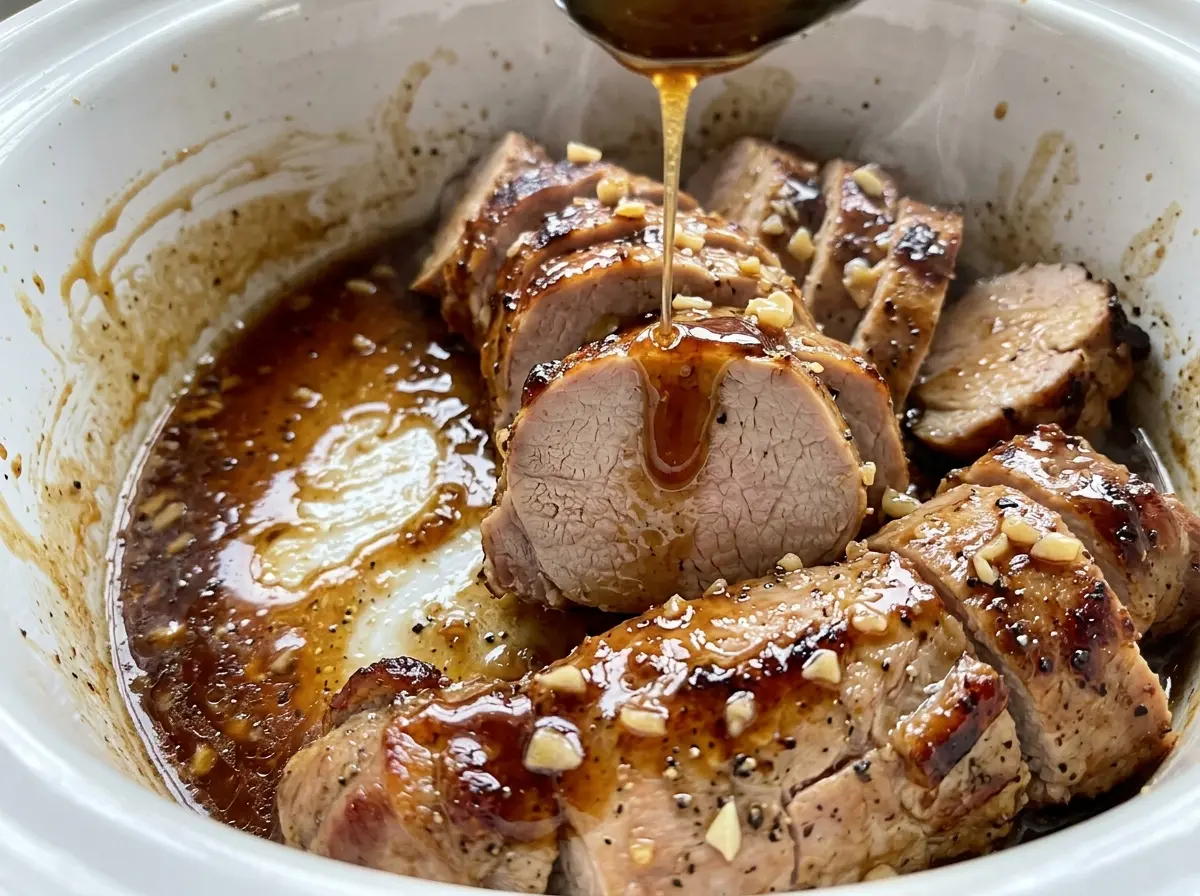
The slow cooker lid lifts to a sweet, savory aroma, and the tenderloins are sitting in a shallow pool of glossy cooking liquid. I learned not to treat this cut like pork shoulder: tenderloin is lean, and it doesn’t need hours of extra cooking to turn tender. This Crockpot Brown Sugar Pork Tenderloin is built around that shorter window, with brown sugar balanced by soy sauce, cider vinegar, Dijon, and garlic.
The sauce goes into the cooker uncooked, so there’s no pan to brown or sauce to reduce first. Keeping the tenderloins in one layer lets the liquid reach both pieces, while the covered cooker holds in moisture. The result is pork you can slice cleanly and serve with the sweet-salty liquid spooned over the top.
Kitchen Note
Set both tenderloins in a single layer instead of stacking one over the other. That small bit of space helps the pieces cook more evenly in the slow cooker.
Save this Crockpot Brown Sugar Pork Tenderloin for a cozy dinner with tender slices and a sweet, savory cooking liquid.
Why Tenderloin Needs a Timer, Not an All-Day Braise
Pork tenderloin and pork shoulder behave differently in a slow cooker. Shoulder has more connective tissue and is suited to a long cook that breaks it down until it pulls apart. Tenderloin is lean and tender to begin with, so extra time doesn’t make it more succulent; it can leave the meat firm and dry instead. That’s why this dish is served in slices rather than pulled into shreds.
The brown sugar mixture seasons the pork as it cooks, but it isn’t a thick barbecue-style coating. The covered slow cooker keeps the liquid around the meat instead of letting it cook down into a glaze. Think of it as a spoonable sauce: sweet from the sugar, savory from the soy and broth, and lifted by the vinegar and mustard. If you go in expecting sliced pork with a balanced cooking liquid—not pulled pork or sticky glazed meat—the texture and finish make sense.
What the Brown Sugar, Soy, and Vinegar Each Bring

- Light brown sugar — Packed sugar dissolves into the cooking liquid and gives it a mellow molasses note. The regular supermarket kind works well here; there’s no need for a specialty sugar.
- Low-sodium chicken broth — It supplies the liquid base without making the sauce as salty as full-sodium broth could. A basic carton is fine, and low-sodium broth leaves the soy sauce room to season the dish.
- Soy sauce — This brings salt and savory depth that plain broth can’t provide. Use the low-sodium chicken broth alongside it as written so the finished liquid stays balanced.
- Apple cider vinegar and Dijon mustard — The vinegar cuts through the sweetness, while Dijon contributes a mild tang and savory edge. Smooth Dijon blends into the liquid more evenly than a coarse, seeded mustard.
- Fresh garlic and black pepper — Minced garlic distributes through the sauce and gives it a warm, aromatic base. Freshly minced garlic has a brighter bite, though prepared minced garlic works when convenience matters.
Mixing the Sauce and Cooking the Pork Without Guesswork
Stir the Brown Sugar Mixture Until Even
In a small bowl, stir together the brown sugar, chicken broth, soy sauce, apple cider vinegar, Dijon mustard, minced garlic, and black pepper. Keep stirring until the sugar is no longer sitting in a dense layer at the bottom of the bowl. The mixture will be thin, not syrupy, and that’s what you want before it goes into the cooker. If a clump of brown sugar remains, break it up with the spoon so it can disperse around the pork.
Arrange the Tenderloins in the Slow Cooker
Set the thawed, trimmed pork tenderloins in a single layer in a 6-quart slow cooker. Pour the brown sugar mixture over them, aiming to coat the tops and let the rest run around the sides. Don’t cut the tenderloins into medallions before cooking; keeping them whole helps them stay moist through the cook. The meat won’t be submerged, and it doesn’t need to be.
Check Each Piece Near the Start of Its Range
Cover and cook on LOW for 3 to 4 hours or HIGH for 2 to 3 hours. Start checking near the beginning of the selected range rather than assuming the longest time is necessary. Insert a thermometer into the thickest part of each tenderloin; the target is 145°F for each piece. Tenderloins can vary in thickness, so check both instead of relying on the reading from just one.
Rest, Slice, and Spoon Over the Liquid
Transfer the cooked pork to a cutting board and let it rest for 3 minutes before slicing. The brief pause gives the juices a chance to settle instead of running straight onto the board. Slice across the tenderloin into even pieces, then serve with the cooking liquid from the slow cooker. The liquid is loose and spoonable, which lets it coat the slices without hiding their texture.
Two Simple Swaps That Change the Finish
Use Gluten-Free Tamari
For a gluten-free version, replace the soy sauce with gluten-free tamari in the same measure. Tamari keeps the savory, salty character close to the original, though its flavor can be a little rounder and less sharp.
Choose Dark Brown Sugar for More Molasses
Swap dark brown sugar for the light brown sugar in the same measure. The added molasses gives the cooking liquid a deeper, more caramel-like sweetness, so the vinegar’s tang may seem a little less pronounced.
Storage and Reheating
- Refrigerator: Store the pork and cooking liquid in an airtight container for 3 to 4 days. The chilled liquid will thicken slightly as the fat and juices cool.
- Freezer: It freezes well for up to 3 months. Pack the slices with some cooking liquid in a freezer-safe container, leaving a little room at the top.
- Reheating: Warm covered in a skillet over low heat with some of the cooking liquid, or microwave in short intervals until the pork reaches 165°F. High heat and long reheating can dry out the lean slices.
Questions That Come Up With Slow Cooker Pork Tenderloin
Crockpot Brown Sugar Pork Tenderloin
Ingredients
Equipment
Method
- In a small bowl, stir together the brown sugar, chicken broth, soy sauce, apple cider vinegar, Dijon mustard, garlic, and black pepper.
- Arrange the pork tenderloins in a single layer in a 6-quart slow cooker.
- Pour the brown sugar mixture over the pork tenderloins.
- Cover and cook on LOW for 3 to 4 hours or HIGH for 2 to 3 hours, checking near the start of the range, until a thermometer inserted into the thickest part of each tenderloin reads 145°F.
- Transfer the pork to a cutting board and rest for 3 minutes.
- Slice the pork and serve with the cooking liquid.