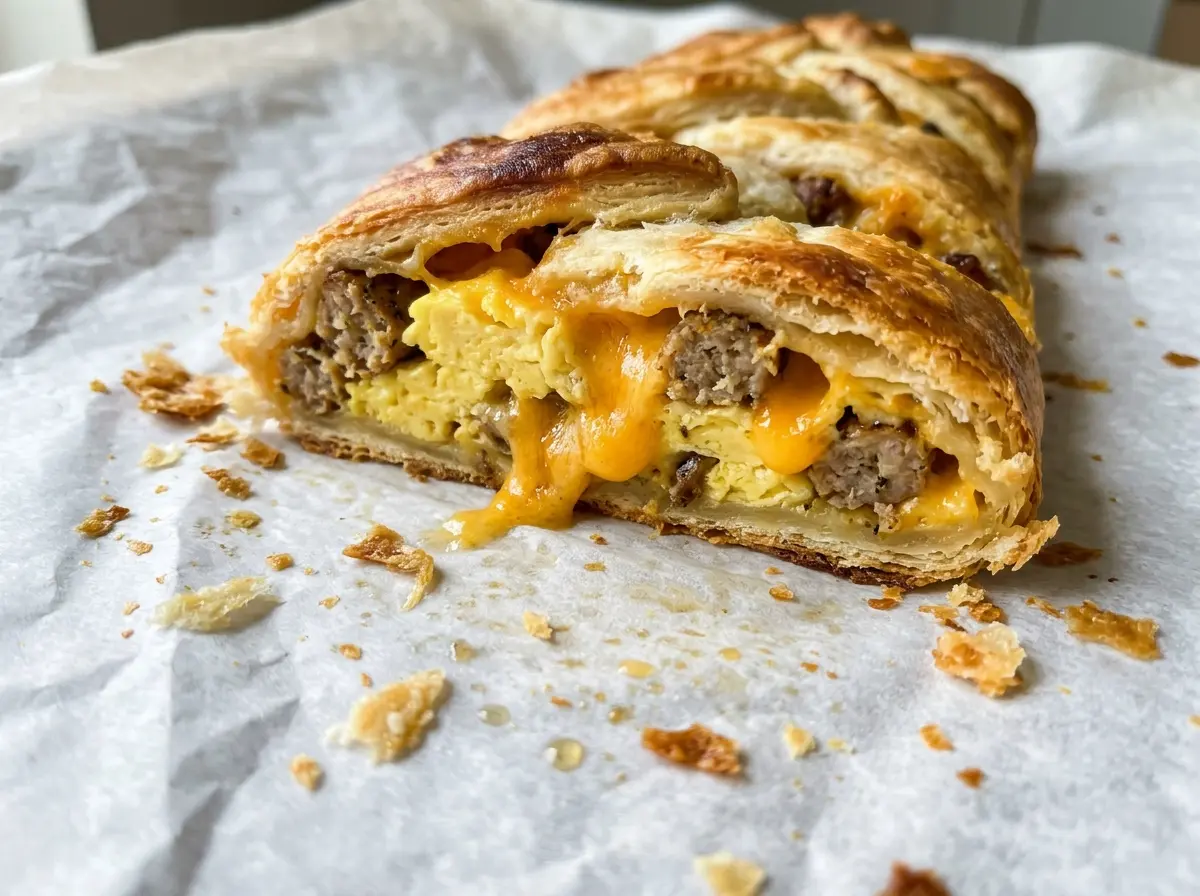
The dough starts to turn golden at the edges before the center looks ready, which is why I watch the whole Breakfast Braid rather than judging it by one corner. A good slice has tender scrambled eggs and browned sausage tucked inside flaky pastry, with cheddar melting through the filling and green onions keeping each bite lively.
I keep the filling in a narrow line down the middle of the crescent dough, then fold the strips over it from alternating sides. That leaves enough pastry to make a braid without burying the filling under a thick layer of dough. Once baked, the top is crisp and golden, and the savory center makes this a satisfying breakfast for six.
Kitchen Note
Let the filling cool for the full 10 minutes before it goes onto the dough. Warm filling makes the pastry softer and harder to braid cleanly, so use that pause to get your baking sheet and dough ready.
Save this Breakfast Braid for a brunch when you want golden pastry wrapped around a hearty sausage-and-cheddar filling.
Why the Filling Needs a Narrow Center Line
A braid can look sturdy on the baking sheet and still turn out doughy in the middle if the filling is spread too wide. The side strips need room to reach across the top and overlap; if the egg mixture creeps into that space, the pastry gets crowded and the braid is harder to close neatly. Keeping the filling lengthwise down the center gives the dough a clear path to cross over it.
The measurements are useful here for more than appearance. A 10-by-13-inch rectangle leaves about 3 inches of dough on either side of the filling, and cutting those sides into 1-inch strips gives you manageable pieces to fold. Alternate sides as you go and overlap the ends slightly. You want a braided top, not a tightly sealed parcel: the dough should cover the filling while still showing the pattern of the strips. If a little filling peeks through, that’s fine; a large gap is more likely to let it spill onto the pan.
What the Sausage, Eggs, and Crescent Dough Each Bring

- Bulk pork breakfast sausage — Bulk sausage breaks into small, even pieces and seasons the filling as it browns. Choose it instead of links so you don’t have to remove casings or deal with larger chunks. Browning it well builds the savory base; drain the rendered fat before adding the eggs.
- Large eggs and milk — The eggs make the filling substantial, while the milk loosens them so they cook into soft curds rather than a dense layer. Use large eggs to keep the filling proportions consistent. Whisk the milk, salt, and pepper with the eggs before they go into the skillet so the seasoning is distributed.
- Shredded cheddar — Cheddar melts into the eggs and helps the filling hold together when sliced. A block shredded at home melts smoothly, while packaged shredded cheddar is a convenient option and works here too. Stir it into the warm filling so it softens without needing a separate sauce.
- Green onions — Their mild, fresh onion flavor cuts through the richness of the sausage and cheese. Thin slices distribute more evenly than large pieces, so each portion gets some without making the filling bulky.
- Refrigerated crescent dough sheet — The sheet gives you one continuous piece of dough to roll into a rectangle and cut into strips. Keep it chilled until you’re ready to shape it; cold dough is easier to handle than dough that has become soft and sticky. The sheet format also avoids having to join perforated triangles.
- Unsalted butter — Butter coats the skillet for cooking the eggs after the sausage is removed. Unsalted butter lets the measured kosher salt season the filling without adding an unknown amount of salt from the butter itself.
Build the Filling and Braid Without Tearing the Dough
Brown the Sausage in a Wide Skillet
Heat the oven to 375°F and line an 18-by-13-inch rimmed baking sheet with parchment paper. In a 12-inch skillet over medium heat, break the bulk sausage into small pieces as it cooks. Give it 6 to 8 minutes, until it’s browned and reaches 160°F. Transfer it to a plate and drain off the fat before moving on.
Cook the Eggs Gently
Melt the butter in the same skillet over medium-low heat. Whisk the eggs with the milk, kosher salt, and black pepper, then pour them into the pan. Stir gently as they cook, scraping through the mixture so the curds stay tender rather than forming one firm sheet. Stop when the eggs are just set; they’ll go into the oven inside the braid.
Combine and Cool the Filling
Stir the cooked sausage, cheddar, and sliced green onions into the eggs until the filling is evenly mixed. Spread the mixture out a little on the plate or in the skillet so it can cool. Give it 10 minutes before assembling; if it still feels warm, allow it a bit longer rather than putting it straight onto the pastry. A cooler filling is easier to handle as you fold the strips over it.
Fold, Bake, and Rest
Unroll the dough on the prepared baking sheet and gently roll it into a 10-by-13-inch rectangle. Spoon the filling lengthwise down the center, leaving about 3 inches of dough on each side, then cut the sides into 1-inch strips. Fold the strips over the filling, alternating sides and overlapping the ends slightly. Bake for 20 to 25 minutes, until the pastry is golden brown and cooked through, then rest the braid for 10 minutes before slicing.
Three Simple Ways to Change the Breakfast Braid
Make It Vegetarian by Leaving Out the Sausage
Omit the sausage and cook the eggs in the butter with the cheddar and green onions. The braid will be less savory and a little lighter, but the egg-and-cheese filling still gives each slice substance. There’s no sausage fat to drain in this version.
Go Mild by Skipping the Green Onions
Leave out the green onions for a more straightforward sausage-and-cheddar filling. The texture stays the same, but the finished braid loses the gentle onion note that balances the richer ingredients.
Leave Out the Cheddar for a Less Rich Filling
For a simpler egg-and-sausage braid, omit the cheddar and keep the other filling ingredients. The filling won’t be as creamy or cohesive when sliced, so let the braid rest before serving and expect a lighter cheese-free taste.
Storage and Reheating
- Refrigerator: Store leftovers in an airtight container for 3 to 4 days. The pastry softens as it sits, but the filling keeps well.
- Freezer: Freeze individual portions, wrapped well, for up to 2 months. Thaw overnight in the refrigerator; the pastry may be less crisp after freezing.
- Reheating: Warm slices in a 325°F oven until the center reaches 165°F. The microwave is quick, but it softens the pastry rather than crisping it.
Questions I Get Asked About This Breakfast Braid
Breakfast Braid
Ingredients
Equipment
Method
- Heat the oven to 375°F.
- Line an 18x13-inch rimmed baking sheet with parchment paper.
- Cook the sausage in a 12-inch skillet over medium heat, breaking it into small pieces, for 6 to 8 minutes, until browned and it reaches 160°F.
- Transfer the sausage to a plate and drain off the fat.
- Melt the butter in the same skillet over medium-low heat.
- Whisk the eggs with the milk, salt, and pepper.
- Cook the eggs, stirring gently, until just set.
- Stir the sausage, cheddar, and green onions into the eggs.
- Let the filling cool for 10 minutes.
- Unroll the crescent dough on the prepared baking sheet and gently roll it into a 10x13-inch rectangle.
- Spoon the filling lengthwise down the center of the dough, leaving about 3 inches of dough on either side.
- Cut the sides into 1-inch strips.
- Fold the strips over the filling, alternating sides and overlapping the ends slightly.
- Bake for 20 to 25 minutes, until the dough is golden brown and cooked through.
- Rest the braid for 10 minutes.
- Slice and serve.