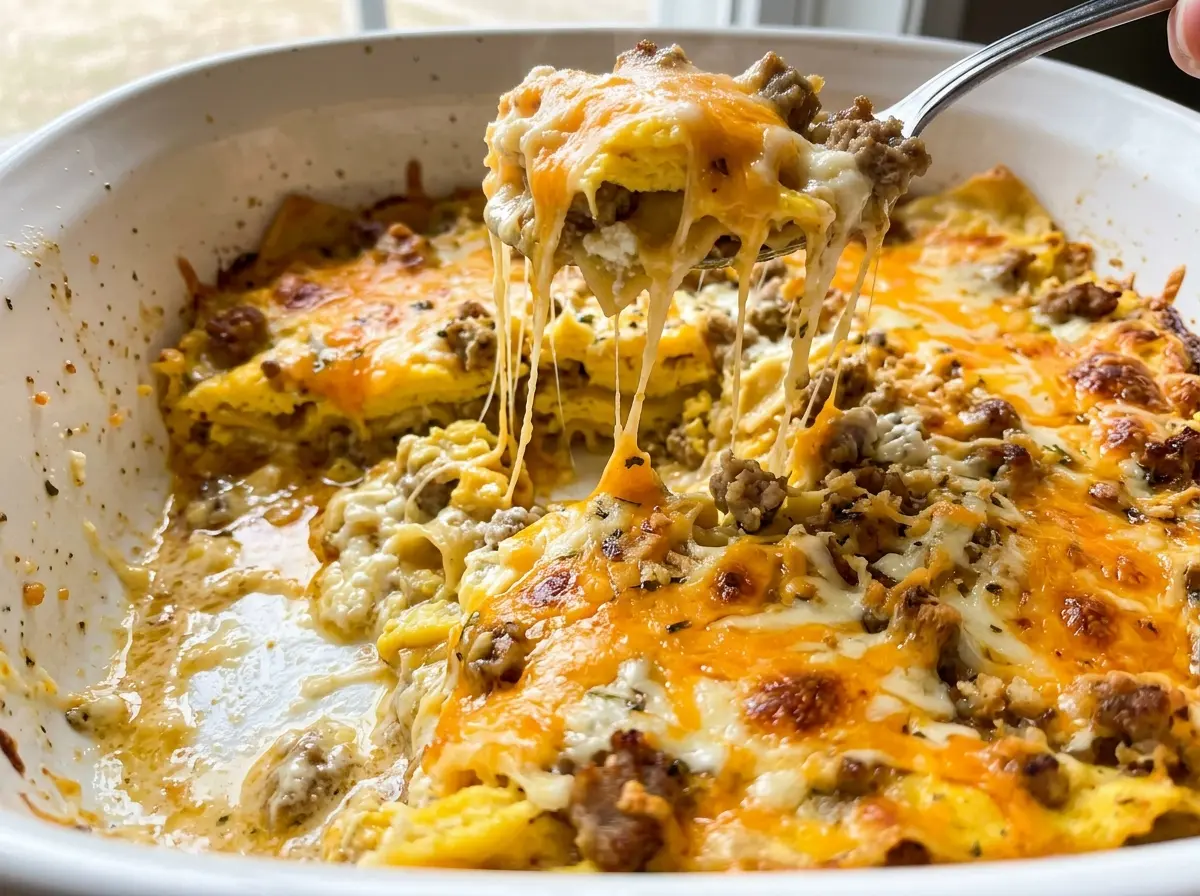
When the sausage gravy goes into the baking dish, it should be thick enough to cling to the noodles but still easy to spread. That balance turns a familiar breakfast of eggs, sausage, and gravy into a sliceable casserole instead of a puddle. I make this breakfast egg lasagna in distinct layers, with the eggs tucked between tender lasagna noodles and the cheddar melting across the top.
The eggs need to come out of the skillet while they’re still soft; they continue cooking in the oven and stay tender inside the layers. The gravy does double duty as both sauce and seasoning, so it belongs between the noodles as well as on top. Once baked, the casserole has browned sausage in every slice, creamy gravy, and a sharp, cheesy top.
Kitchen Note
Give the casserole its full 10-minute rest before slicing. The layers settle during that pause, so you get tidy pieces that hold together instead of sliding apart on the serving spatula.
Save this breakfast egg lasagna for a brunch bake with tender eggs, sausage gravy, and cheddar layered between pasta.
Why the Top Layer Needs Gravy, Not Just Cheese
In a traditional pasta bake, it’s easy to think of the sauce as something that mainly fills the middle. Here, the final layer of noodles needs the sausage gravy too. Without that coating, the exposed pasta can dry out while the casserole bakes, even with cheese on top. The gravy keeps the noodles tender and carries the sausage seasoning through the whole dish.
The layers are intentionally simple: gravy under the first noodles, eggs in the two middle layers, and gravy over the final noodles. That gives each slice a clear pasta-and-egg structure instead of turning everything into one dense filling. The sharp cheddar melts into the gravy and helps the top set, while the noodles give the soft eggs something sturdy to sit between.
Think of the gravy as the sauce that ties the casserole together, not just a breakfast topping. If it spreads easily over a noodle without running like milk, you’re in the right range for stacking these layers.
What the Sausage, Milk, and Cheddar Each Bring to the Layers

- Lasagna noodles — Regular dried noodles hold their shape through boiling and baking; an inexpensive box works well here. Cook them only until just tender, since they soften further in the oven. No-boil noodles aren’t a reliable swap for this gravy-based bake.
- Breakfast sausage — Its seasoning builds the flavor of the gravy, and the browned crumbles give each bite a hearty texture. Bulk sausage is easiest to break into small pieces, but sausage links work if you remove the casings first. Hot breakfast sausage is an easy way to bring more heat.
- All-purpose flour — Flour thickens the milk into a sauce that can coat the pasta. Stirring it with the browned sausage before adding milk helps it disperse instead of forming dry clumps. A cup-for-cup gluten-free flour blend is the most useful swap if you need to avoid wheat.
- Whole milk — Whole milk gives the gravy a fuller body than skim milk, but a store-brand carton is fine. Two-percent milk works in the same way, though the gravy will be a little less rich. Use it in place of the whole milk without changing the cooking sequence.
- Large eggs — The eggs make the soft, savory layers that distinguish this from a sausage-and-gravy pasta bake. Large eggs are the right size for the intended balance; there isn’t a simple substitute that gives the same tender curds.
- Sharp cheddar — Its tang stands up to the sausage and creamy gravy. Grating a block gives the smoothest melt, though pre-shredded cheddar is convenient and works. Monterey Jack melts well in its place for a milder finish; pepper Jack brings a little heat.
Build the Layers Without Overcooking the Eggs
Boil the Noodles Until Just Tender
Bring a large pot of water to a boil and cook the lasagna noodles according to the package directions. Check a noodle near the end of its cooking time; it should bend easily but still have enough structure to lift from the pot. Drain them once they’re just tender, rather than waiting for them to feel soft and floppy. They’ll spend more time cooking in the oven.
Brown the Sausage Before Adding the Milk
In a 12-inch skillet over medium heat, cook the breakfast sausage for 8 to 10 minutes, breaking it into small pieces as it browns. It should be browned throughout and reach 160°F. Sprinkle the flour over the sausage and stir for 1 minute, then gradually whisk in the milk so it blends without lumps. Simmer for 5 to 7 minutes, stirring often, until thickened, then stir in the salt and black pepper.
Keep the Scrambled Eggs Soft
Beat the eggs with the milk until the yolks and whites are fully blended. Melt the butter in a 10-inch nonstick skillet over medium-low heat, add the eggs, and stir gently as they set. After 4 to 6 minutes, they should be softly set rather than firm and dry. Take them off the heat at that point; the oven will finish cooking them.
Layer the Casserole and Bake Until Bubbling
Heat the oven to 350°F and coat a 9×13-inch baking dish with nonstick cooking spray. Divide the gravy into four portions: start with one in the dish, then layer three noodles, half the eggs, gravy, and cheese; repeat with the next three noodles and remaining eggs, gravy, and cheese. Finish with the last three noodles, the remaining gravy, and the remaining cheese. Cover with foil and bake for 25 minutes, then uncover and bake for 15 to 20 minutes, until the edges bubble and the center reaches 160°F.
Easy Ways to Change the Sausage or Make It Gluten-Free
Make It with Hot Breakfast Sausage
Swap in hot breakfast sausage for the regular breakfast sausage and use the same browning and gravy method. The layers keep their familiar creamy texture, with extra peppery heat in each bite.
Make the Lasagna Gluten-Free
Choose gluten-free lasagna noodles and cook them according to their package directions. Use the same quantity of a cup-for-cup gluten-free flour blend for the gravy; check that it thickens before assembling, since blends can behave a little differently from all-purpose flour.
Storage and Reheating
- Refrigerator: Refrigerate covered portions within 2 hours and keep them for 3 to 4 days. The noodles soften as they absorb gravy, so the layers won’t be quite as distinct later.
- Freezer: Freeze individual slices in airtight containers or wrap portions tightly for up to 2 to 3 months. Thaw overnight in the refrigerator for more even reheating.
- Reheating: Cover a slice and warm it in the oven or microwave until the center reaches 165°F. Leaving it uncovered for too long can dry the noodles and cheese.
Questions That Come Up When Making Breakfast Egg Lasagna
Breakfast Egg Lasagna
Ingredients
Equipment
Method
- Bring a large pot of water to a boil and cook the lasagna noodles according to the package directions until just tender; drain.
- Cook the sausage in a 12-inch skillet over medium heat for 8–10 minutes, breaking it into small pieces, until browned and cooked to 160°F.
- Sprinkle the flour over the sausage and stir for 1 minute.
- Gradually whisk in the 3 cups milk, then simmer for 5–7 minutes, stirring often, until thickened.
- Stir in the salt and black pepper.
- Beat the eggs with the remaining 1/4 cup milk.
- Melt the butter in a 10-inch nonstick skillet over medium-low heat, add the eggs, and cook for 4–6 minutes, stirring gently, until softly set.
- Heat the oven to 350°F and coat a 9x13-inch baking dish with cooking spray.
- Divide the gravy into 4 portions and spread one portion in the dish.
- Layer 3 noodles, half the eggs, another portion of gravy, and 1 cup cheese.
- Repeat with 3 noodles, the remaining eggs, a third portion of gravy, and 1 cup cheese.
- Top with the final 3 noodles, remaining gravy, and remaining cheese.
- Cover the dish with foil and bake for 25 minutes.
- Uncover and bake for 15–20 minutes, until bubbling at the edges and the center reaches 160°F.
- Rest for 10 minutes before slicing and serving.